

Las Chimeneas Cave
Category
Zona
Ubicación
Tags
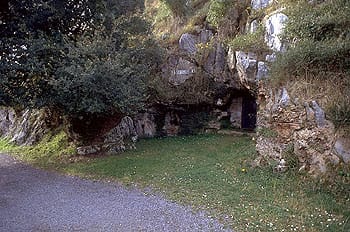
Las Chimeneas Cave was discovered in 1953 by a team of road workers from the Regional Council (Diputación Regional) who, under the direction of A. García Lorenzo, were building the access road to El Castillo and La Pasiega caves. The discovery was published in 1956 by J. González Echegaray. In the original vestibule, a few non-diagnostic flints were uncovered, along with the remains of a burial dating back to Recent Prehistory.
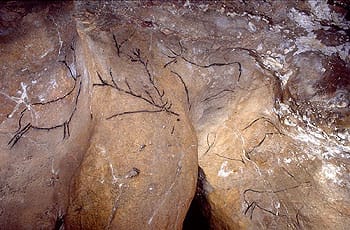
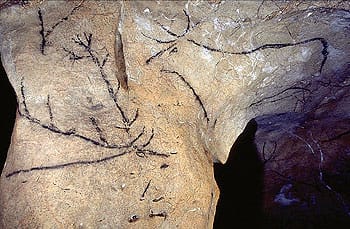
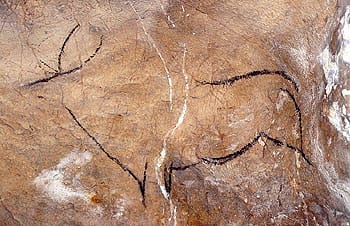
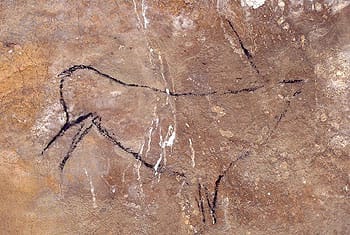
The cave features several panels of ‘macaroni-style’ finger flutings in the area near the original vestibule, depicting some animals and non-figurative motifs. Further inside, there is a large panel of finger flutings along with other isolated figures.
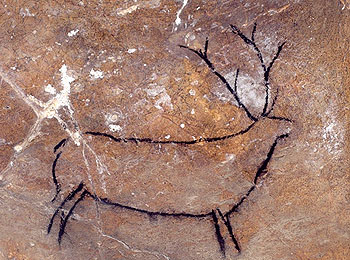
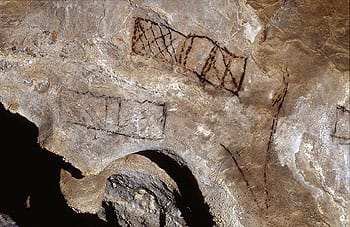
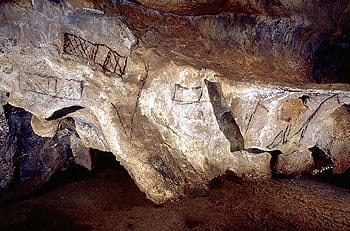
The collection of black paintings is located at the back of a chamber, while the adjacent small galleries feature depictions of animals and quadrangular signs. The engravings were executed using the ‘macaroni’ technique, with the sole exception of a bovid that features incised horns. The quadrupeds are very simplistic, generally representing aurochs, cervids, and caprids. The first panel of black paintings displays quadrangular signs rendered in black. In the small nearby galleries, large stags and a horse head are depicted.
Stylistically attributable to Leroi-Gourhan’s Style III from the Solutrean period, the complex has nevertheless been dated to the Magdalenian. Two figures (a deer and a sign) have been dated by Carbon-14 to 13,940 and 15,070 years ago, respectively.
|
Estilo artístico |
Paleolithic cave art |
|
Acceso |
To access Las Chimeneas Cave, you must first reach the town of Puente Viesgo, where you take a road that leads up to Mount Castillo. There is a parking lot from which you can walk to the Visitor Center and the various caves within the complex (El Castillo and Las Monedas—which are open to the public—La Flecha, La Pasiega, and Las Chimeneas). |
|
Época |
|
|
Características |
A cave with a complicated layout, featuring two levels connected by karst chimneys, which give the cave its name. The current entrance, which is artificial, is located on the upper level. This upper level is labyrinthine and lacks archaeological interest. The lower level once had an entrance, which is currently blocked, and also features a complex layout.
|