

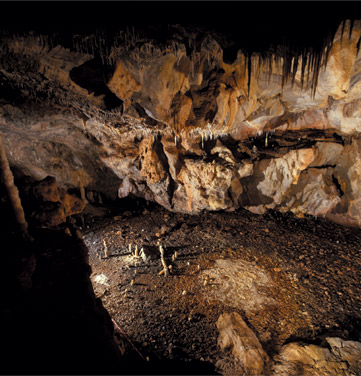
In the early 1990s, following the discovery of the nearby La Garma B Cave, members of the G.E.I.S. Carballo/Raba group located the entrance and the archaeological site of the upper level of La Garma A. In 1996, during archaeological excavations in the upper level’s vestibule—directed by P. Arias and R. Ontañón—two team members, J. M. Ayllón and A. Serna, discovered the gallery of paintings on the lower level while exploring and surveying the system. Currently, excavation and documentation work across the entire complex remains ongoing, conducted by a team from the Department of Historical Sciences at the University of Cantabria.
The upper vestibule features a complex stratigraphy, with layers containing human burials as well as Mesolithic, Upper, and Lower Paleolithic occupation levels. The intermediate level holds a large number of paleontological remains, primarily bear bones, alongside Lower Paleolithic stone tool industries. However, the most significant remains are those located on the lower level, where three distinct, completely intact sites can be identified. A Magdalenian occupation site has been documented in the original vestibule, featuring several complex structures; beneath the main painted panels, another Paleolithic surface site is visible; and directly under the chasm that connects to the intermediate gallery, several burials from the Early Middle Ages are located.
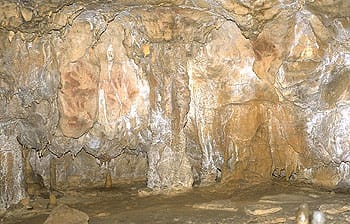
The artistic manifestations are distributed throughout almost the entire lower level. In the original vestibule, there are numerous panels of paintings and engravings. Rock art continues into the surrounding areas and the adjacent grand chamber, arranged in highly complex panels. Deep within the cavity, abundant paintings extend all the way to the chamber housing the chasm that connects to the active lower level where the river flows. Nevertheless, the Paleolithic rock art of this cave is still only partially known, as it is currently undergoing documentation and study.
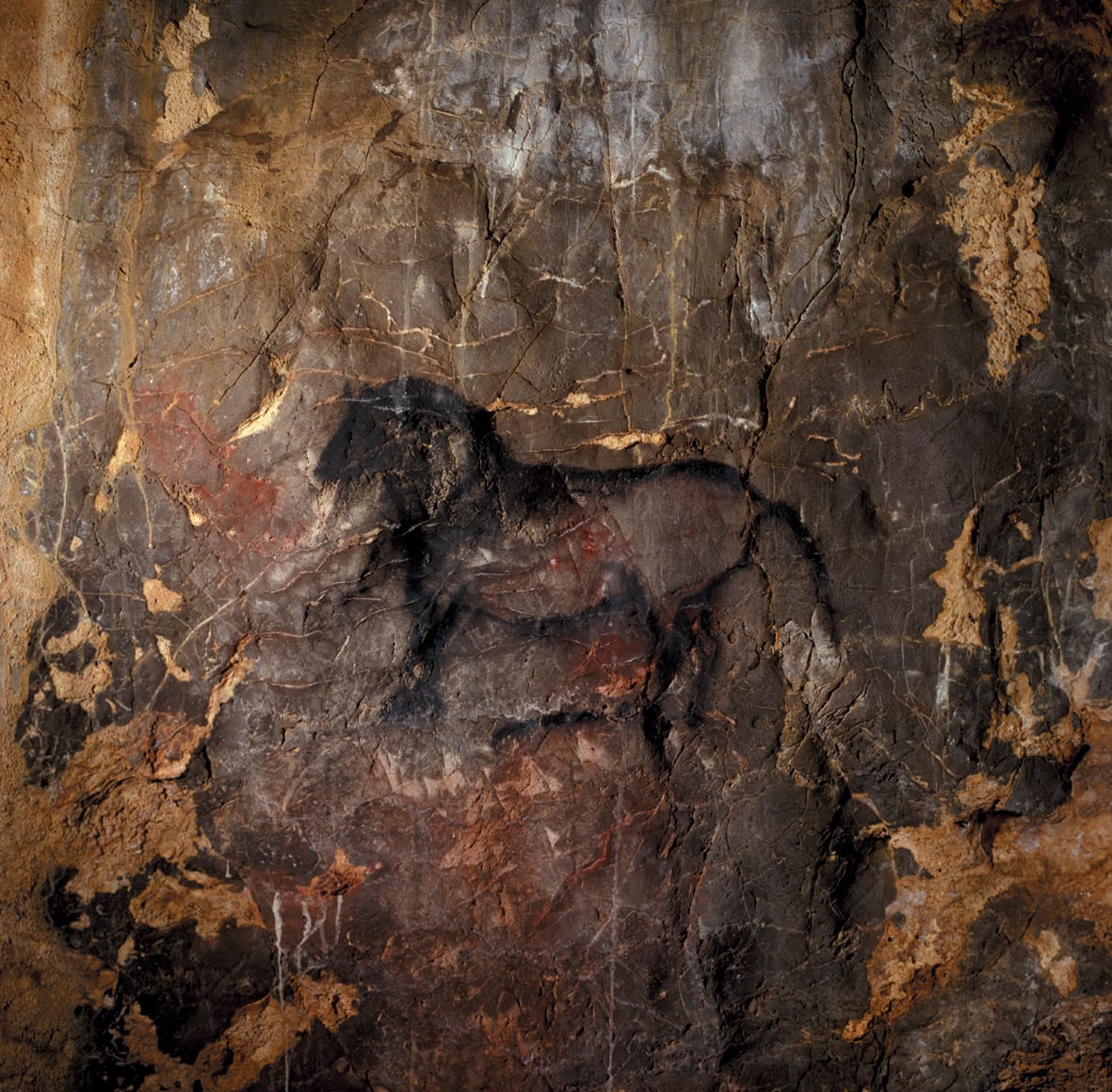
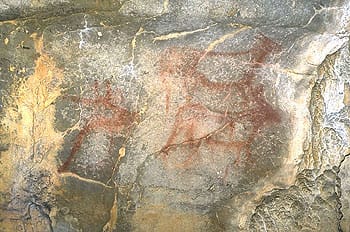
The original vestibule contains a vast number of engravings and paintings. Among the painted figures, a large, highly naturalistic horse rendered in black stands out, along with abundant red paintings representing signs. In nearby areas, black paintings depicting various quadrupeds were found, alongside some red paintings.
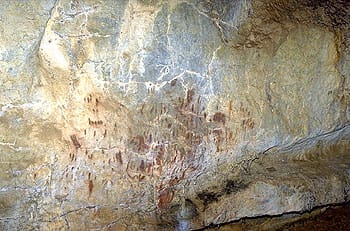
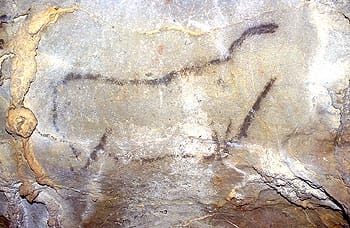
Further inside, within a massive chamber, lies a large panel featuring red paintings with engraved outlines; these depict the forequarters of a bovid, a cervid, and several ibexes, as well as simpler red figures. From here to a smaller rear chamber, and along the corridor connecting them, a large number of paintings appear—mostly red—consisting of complex signs, dots, and three bisons. This final chamber leads into a corridor that reaches a grand gallery, one of whose branches opens into the chasm chamber connecting to the intermediate level. Throughout this area, red paintings are found, typically representing signs and negative hand stencils. At the back of the cave, in the chamber where the chasm descends to the active level, there are complex panels with negative hand stencils and signs, as well as isolated paintings, most notably a bison rendered in black.
Stylistically, the rock art can be framed within Leroi-Gourhan’s Styles II, III, and IV. The red hands and signs at the back of the gallery belong to Style II. The depictions of ibexes, an aurochs, a red hind, and a large number of complex signs belong to Style III. Finally, Style IV includes certain black figures, such as the shaded horse, which are distributed from the vestibule to the back of the cave, where the aforementioned bison hindquarters are located. Its probable chronology spans from the late Aurignacian period (around 28,000 years ago) to the Middle Magdalenian period (around 13,000 years ago).
|
Estilo artístico |
Paleolithic cave art |
|
Acceso |
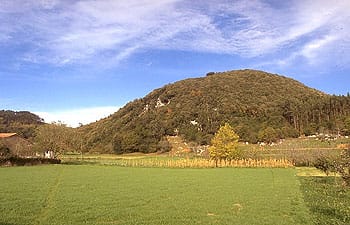
The cave opens up right on the La Garma hill, in the village of Omoño (Ribamontán al Monte). From this town, a small path leads to the mouth of the upper gallery. |
|
Época |
|
|
Características |
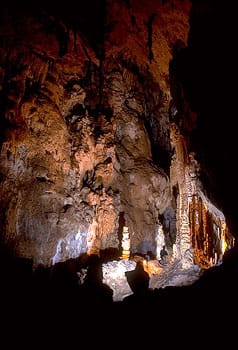
La Garma Cave is an active resurgence featuring three fossil levels and abundant karst formations. The upper level, which contains the only currently accessible entrance, has a small vestibule that leads into a winding gallery ending in a chasm. Beyond this chasm lies the wider intermediate level, whose original mouth is blocked. At the end of this gallery, a second chasm opens up, descending to the central area of the lower level. This lower level boasts large corridors and chambers, particularly around the ancient original vestibule, which is also currently blocked. From the lower level, a third chasm allows descent to the system’s active level, where an underground river flows.
|